How Running Actually Affects Your Pelvic Floor (It's Not All Bad News)
Quick Answer: Running itself doesn’t damage a healthy, well-coordinated pelvic floor — the repetitive impact is manageable for most women. Leaking during runs usually signals a coordination or load-tolerance issue, not that running is inherently harmful, and it’s often fixable.
You’ve seen the warnings: running is ‘hard’ on the pelvic floor, high-impact is risky, maybe you should switch to swimming. Meanwhile you love running and don’t want to quit over a vague fear. Here’s the more useful, less alarmist version of the story.


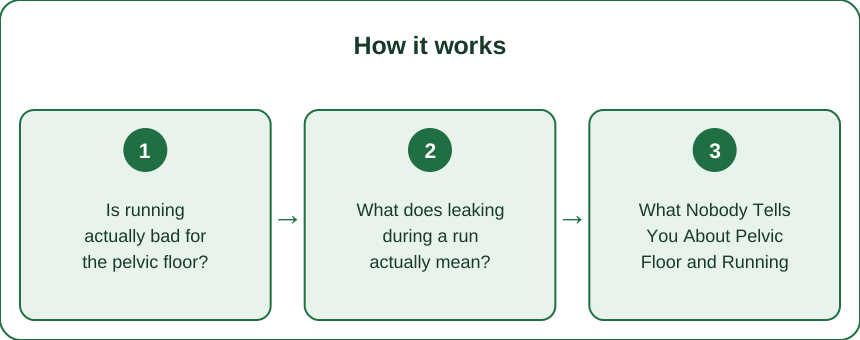
Is running actually bad for the pelvic floor?
Not inherently. Research on postpartum and general populations shows that a well-conditioned pelvic floor tolerates running’s impact just fine — the issue isn’t the sport, it’s whether the pelvic floor can currently absorb and respond to that impact with each stride.
Each foot strike creates a small downward pressure wave; a functioning pelvic floor reflexively contracts to meet it. When that reflex is weak, delayed, or overly tense, symptoms like leaking or heaviness show up — not because running is dangerous, but because the system isn’t yet matched to the load.
What does leaking during a run actually mean?
Leaking (stress incontinence) during running is common — studies put it at roughly 1 in 4 to 1 in 3 female runners — but common doesn’t mean it should be ignored or is simply ‘normal to live with.’
It typically means the pelvic floor’s timing or strength hasn’t caught up to your current running volume or intensity, often after pregnancy, a training ramp-up, or years of habitual straining or breath-holding elsewhere in training.

What Nobody Tells You About Pelvic Floor and Running
Here’s what rarely gets said: a tense, overly tight pelvic floor causes just as many problems as a weak one. Kegels aren’t a universal fix — for some runners with leaking, the actual issue is a pelvic floor that’s chronically gripped and can’t relax enough to coordinate properly, and more squeezing makes it worse, not better.
This is why a pelvic floor physical therapist assessment beats guessing: they can tell you whether you need strengthening, relaxation training, or load management — three very different fixes for the same symptom.
FAQ: Running and Pelvic Floor Questions, Answered
Should I stop running if I leak a little?
Not automatically — but treat it as a signal worth addressing, not something to just pad through indefinitely. Many runners resolve it with targeted rehab while continuing to run.
Does running make pelvic organ prolapse worse?
For most women with mild prolapse, moderate running is manageable with proper pelvic floor support; higher-grade prolapse needs individualized guidance from a pelvic health specialist before resuming high-impact training.
How long does pelvic floor rehab for runners usually take?
Many women see meaningful improvement in 6-12 weeks of targeted work, though timelines vary by cause and consistency. This is general information, not medical advice — see a pelvic floor PT for a personal plan.
TL;DR:
- A well-conditioned pelvic floor tolerates running’s impact fine — the sport itself isn’t the enemy
- Leaking signals a coordination or load-tolerance gap, not permanent damage
- Kegels aren’t universal — a too-tight pelvic floor needs relaxation training, not more squeezing
- A pelvic floor PT assessment beats guessing which fix you actually need
Leaking during runs is common and fixable — it’s worth a proper assessment, not a quiet switch to the elliptical forever.
Keep Reading
This article is for general informational purposes only and is not medical advice. Always consult a qualified health professional for guidance specific to you.