Why Pelvic Floor Symptoms Show Up on Stairs Before They Show Up Running
Quick Answer: Descending stairs produces a single large eccentric load with an unpredictable rhythm, often while you are carrying something and breathing irregularly. Running is repetitive, rhythmic, and predictable, which lets the pelvic floor pre-activate. The floor manages anticipated loads far better than unanticipated ones, so stairs expose weakness that running does not.
You have been running for months without an issue. Then you go down the stairs at home carrying a laundry basket and you leak.
It feels backwards — running is obviously higher impact. But the pelvic floor does not respond to impact magnitude alone. It responds to how much warning it gets, and stairs give it almost none.

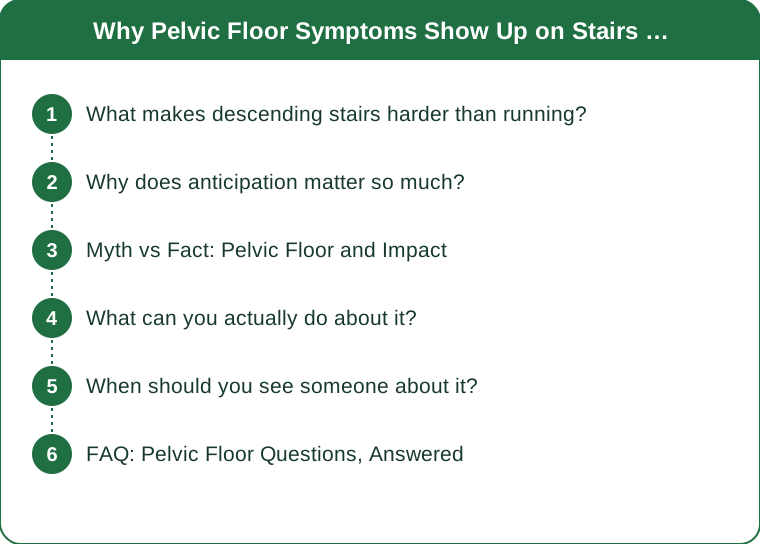
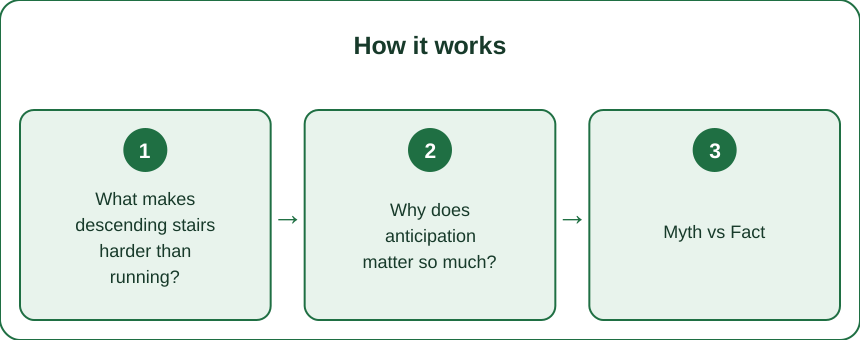
What makes descending stairs harder than running?
Four things, and they combine badly.
Eccentric loading is higher. Going down stairs, your leg muscles are lengthening under load to control your descent. Eccentric contractions generate more force than concentric ones, and that force transmits upward through the pelvis. Descending is harder than ascending for this reason, which is why most people’s symptoms are on the way down.
The rhythm is irregular. Running is metronomic — same step, same interval, same force. The pelvic floor can and does pre-activate to a predictable rhythm. Stairs have variable step heights, landings, turns, and a step you sometimes take two at a time. Anticipatory activation cannot happen reliably when the timing is unpredictable.
You are usually carrying something. Laundry, a child, shopping, a bag. Carried load increases intra-abdominal pressure and occupies the arms, which reduces trunk stability.
Breathing is disorganised. Running has a breathing pattern. Stairs frequently involve breath holding, particularly with a load — and breath holding raises intra-abdominal pressure substantially, which is the single largest driver of downward force on the pelvic floor.
The result: running is a large number of moderate, predictable loads that the floor can prepare for. Stairs are a smaller number of larger, unpredictable loads arriving while pressure is already raised.
Why does anticipation matter so much?
Because the pelvic floor’s most important function is a reflex that happens before the load arrives, not after.
In a well-functioning system, the pelvic floor contracts fractionally before an anticipated increase in pressure. This is a feed-forward mechanism — it is automatic, it does not require conscious effort, and it is what keeps you continent through most of daily life without you ever thinking about it.
That reflex depends on the load being predictable. A rhythmic activity gives it a pattern to lock onto. An unexpected cough, a sudden step down, or a stumble does not.
This is why the classic symptom sequence goes: cough and sneeze first, then stairs, then jumping, then running. It runs from least predictable to most predictable, not from smallest force to largest.
What this tells you diagnostically: if you leak on stairs but not running, the issue is more likely to be timing and coordination of the reflex than raw strength. Those need different interventions. Strength training a floor that has a timing problem does not fix the timing, which is why people who do a lot of squeezes and see no change are often working on the wrong thing.
Myth vs Fact: Pelvic Floor and Impact
Myth: higher impact always means higher pelvic floor demand. Fact: predictability matters as much as magnitude. A predictable high-impact activity can be easier to manage than an unpredictable moderate one.
Myth: if I can run, my pelvic floor is fine. Fact: running tests one thing — rhythmic, anticipated loading. It does not test the reflex response to unexpected pressure, which is what stairs, coughs, and stumbles demand.
Myth: more squeezes will fix it. Fact: if the problem is timing or excess tension rather than weakness, more squeezing can make it worse. A tight, over-active pelvic floor produces very similar symptoms to a weak one and needs the opposite approach — this is one of the most common reasons self-managed programmes fail.
Myth: it is a normal part of having had children, or of getting older. Fact: it is common, which is not the same as normal or unavoidable. Pelvic floor symptoms respond well to appropriate treatment at any age, and prevalence is not a reason to accept them.
Myth: I should stop doing stairs. Fact: avoidance reduces symptoms and also reduces the loading that maintains capacity. Modifying how you do them is better than avoiding them.

What can you actually do about it?
Address the breathing first, then the timing, then the load.
The breathing fix, which is the highest-value change:
- Exhale on the effort. Going down a flight, breathe out as you descend rather than holding. Breath holding is the single largest contributor to the pressure spike.
- Never hold your breath while lifting a load onto a step. This combination — held breath plus eccentric load plus carried weight — is the worst case available.
The timing work:
- The knack. Consciously contract the pelvic floor just before a known load: before you start down the stairs, before you cough, before you lift. This deliberately replicates the reflex that is not firing on its own, and with practice it becomes automatic again. It is well established and it is the most useful single technique for this symptom pattern.
- Practise on predictable loads first. Contract before stepping down a single step, ten times. Then a short flight. Building the pattern where it is easy transfers to where it is hard.
The load modification:
- Carry less per trip. Two trips with half the load each is genuinely better, and this is the change people resist most.
- Use the handrail. It transfers a meaningful fraction of the load to your arm and reduces the eccentric demand on the legs.
- Slow down. Faster descent means higher peak forces.
The strength and coordination work, if appropriate:
- 3 sets of 10 slow contractions with full relaxation between, plus 3 sets of 10 quick contractions, daily. The quick ones train the reflex speed that stairs demand, and they are frequently skipped.
- Full relaxation between repetitions is as important as the contraction. A floor that never fully relaxes cannot contract strongly when needed.
This is general information, not medical advice.
When should you see someone about it?
Sooner than most people do, and there is a specific reason for that.
Worth getting assessed:
- Any leaking, at any volume, at any age — it is common and it is treatable, and it responds better earlier
- A feeling of heaviness or dragging in the pelvis, particularly if it worsens through the day
- Symptoms that have not improved after eight to twelve weeks of consistent, correct exercises
- Pain with intercourse, or difficulty inserting a tampon, both of which can indicate an over-active floor rather than a weak one
- Any change in bowel or bladder function that is new
Why a pelvic health physiotherapist specifically: an internal assessment is the only reliable way to distinguish a weak floor from a tight one, and the two require opposite treatment. Getting this wrong is the most common reason months of exercises produce nothing. A substantial proportion of people who are told to do more squeezes actually need to learn to relax.
What to expect: an assessment, an individualised programme, and usually a review at six to eight weeks. Most people see meaningful change within three months of appropriate treatment.
This is general information, not medical advice — an individual assessment is what determines the right approach for you.
FAQ: Pelvic Floor Questions, Answered
Why is going down worse than going up?
Descending is eccentric — your muscles lengthen under load to control the drop — and eccentric contractions generate higher forces. Ascending is concentric and generates less. Almost everyone with this symptom pattern reports the descent as the harder direction.
Does this mean I should stop running?
No. Running is not causing the problem and stopping will not fix it. If running is symptom-free, it is a reasonable activity to continue while you address the stairs issue.
Why is it worse some days than others?
Several reasons: where you are in your menstrual cycle, how tired you are, whether you are constipated, and whether you have a cough. Symptom variability is normal and does not mean the problem is imaginary or that your programme is failing.
Does carrying a child on one hip make it worse?
Usually yes, and noticeably. Asymmetric carrying shifts trunk position and changes how pressure distributes, on top of the added load. Alternating sides helps, and a carrier that distributes load across both shoulders helps more.
TL;DR: Stairs are harder than running because they are unpredictable, not because they are heavier.
- Descending is eccentric loading — higher force than ascending, which is why it is the direction that catches people.
- The pelvic floor’s key mechanism is a reflex that fires before an anticipated load. Irregular rhythm defeats it.
- Carrying something and holding your breath both raise intra-abdominal pressure at exactly the wrong moment.
- Exhale on the descent, contract before you start, use the handrail, carry less per trip.
- Train quick contractions as well as slow ones — stairs demand speed, not just strength.
If you leak on stairs but not running, the issue is more likely timing than strength — and a tight floor causes the same symptoms as a weak one, which is why an assessment beats guessing.
Keep Reading
This article is for general informational purposes only and is not medical advice. Always consult a qualified health professional for guidance specific to you.