Why Does Autumn Coughing Season Set Back Pelvic Floor Progress?
Quick Answer: Coughing generates one of the highest intra-abdominal pressure spikes the body produces, and it drives that pressure downward onto the pelvic floor. During a two-week respiratory infection you may cough several hundred times a day, which is a very high volume of maximal loading on tissue that is not being given time to recover. This is why symptoms that had improved often return during cold season, and why the setback feels sudden.
You did the work. Symptoms improved. Then you caught something in October and it all came back.
It is not that the work did not hold. It is what a cough actually is.
This is general information, not medical advice.

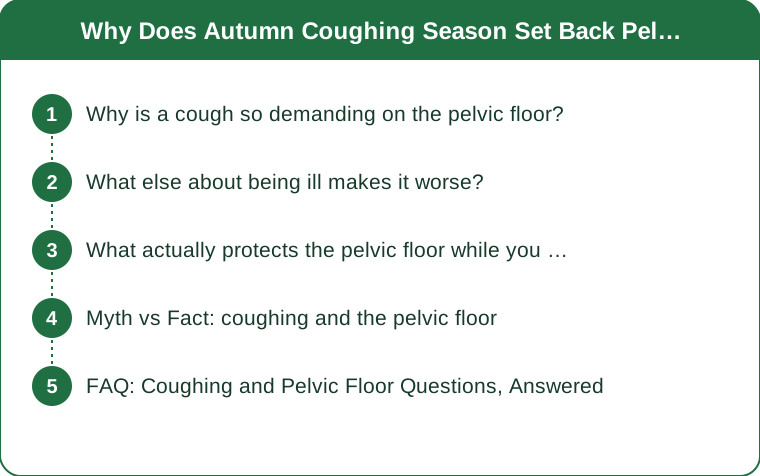
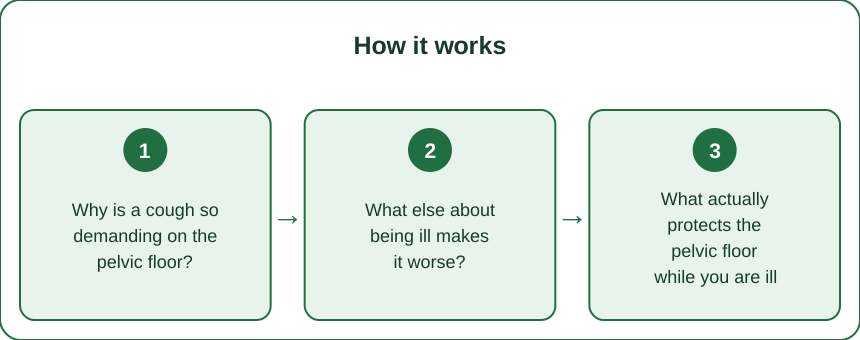
Why is a cough so demanding on the pelvic floor?
Because of what it is mechanically.
A cough is a rapid, forceful expulsion of air produced by a sharp contraction of the diaphragm and abdominal wall against a briefly closed airway. That combination creates a sudden and very large spike in intra-abdominal pressure — among the highest values the body generates in ordinary life, comparable to or exceeding heavy lifting.
That pressure has to go somewhere. The abdominal cavity is bounded by the diaphragm above, the abdominal wall in front, the spine behind, and the pelvic floor below. When pressure rises sharply, the pelvic floor is the downward boundary receiving it.
In a well-coordinated system, the pelvic floor contracts reflexively just before the pressure arrives, bracing against it. This anticipatory response is automatic and fast.
The problem during illness is not usually that the reflex fails. It is volume and fatigue:
- Frequency. A person with a significant chest infection may cough hundreds of times a day. That is hundreds of maximal-pressure events, repeated for days.
- Fatigue. Like any muscle, the pelvic floor fatigues with repeated maximal work, and the anticipatory contraction becomes progressively less effective as the day goes on.
- No recovery window. A heavy training session is followed by rest. A cough is followed by another cough.
So the setback is a loading problem rather than a technique problem, and that is a more optimistic framing than it first appears.
Is this why symptoms are worse in the evening when I am ill?
Very likely. Cumulative fatigue across a day of coughing means the same cough is less well braced at 8pm than at 8am.
What else about being ill makes it worse?
The cough is the main event and it does not act alone.
Reduced activity. Several days on the sofa means less general movement, and both the pelvic floor and the surrounding musculature respond to disuse. This is a small effect over a week and a real one over three.
Changed breathing patterns. Congestion often pushes people into shallow upper-chest breathing. The diaphragm and pelvic floor work together as a coordinated pressure system, moving in synchrony with the breath, and disrupted breathing mechanics disrupt that coordination.
Constipation. Reduced movement, lower fluid intake, appetite changes, and some cold and flu medications all contribute. Straining on the toilet is itself a significant downward pressure event, and it frequently accompanies illness at exactly the wrong moment.
Sneezing. Everything true of coughing applies to sneezing, and autumn brings both infections and, for many people, mould and late-season allergen exposure.
Interrupted routine. Pelvic floor training is a habit, and habits break when you are unwell. Two weeks of not doing the exercises coincides with two weeks of maximal loading — the worst possible combination of timing.
Does the type of illness matter?
Duration and cough intensity matter more than the specific illness. A persistent dry cough lingering for weeks after the infection has cleared can be more cumulatively demanding than a few days of severe illness.

What actually protects the pelvic floor while you are ill
Several things genuinely help, and one of them is worth more than the rest combined.
1. The Knack — brace before the cough. This is the highest-value technique available, and it is well established in pelvic health practice. As you feel a cough coming, deliberately contract and lift the pelvic floor before the cough happens, and hold through it.
The timing is the whole point. A contraction after the cough achieves nothing. Practised deliberately, this becomes automatic within days, and it substantially reduces leakage during coughing for many people.
2. Change your position. Coughing while leaning forward slightly, or with a hand supporting the perineum through clothing, reduces the downward load. Crossing the legs while coughing is a commonly taught practical strategy. Coughing while lying flat is generally more demanding than coughing while upright and supported.
3. Treat the cough itself. This is often overlooked in pelvic health advice and it is straightforward: reducing the number of coughs reduces the loading directly. Managing the underlying cause, staying well hydrated, and using appropriate remedies all reduce total cough count. Fewer coughs is fewer pressure events.
4. Prevent constipation actively. Fluid, fibre where appetite allows, and not straining. Use a footstool to raise the knees above the hips on the toilet, which improves the mechanical angle and reduces the need to strain.
5. Keep doing something, gently. Full training may not be realistic while ill. A small number of gentle contractions, done with correct technique, maintains the habit and the coordination. This is maintenance rather than progress, and maintenance is the correct goal for that fortnight.
6. Breathe low when you can. Whenever you are not actively coughing, slow diaphragmatic breathing helps restore the coordination between diaphragm and pelvic floor that congestion disrupts.
How soon can I return to normal training afterwards?
Usually as soon as the coughing has largely settled. Rebuild gradually rather than resuming at your previous level immediately — the tissue has had a demanding fortnight.
Myth vs Fact: coughing and the pelvic floor
Myth: Leaking when you cough means your pelvic floor training failed. Fact: It means the system was loaded harder than usual. Symptoms that return during illness and settle afterwards indicate a loading problem, not lost progress.
Myth: You should stop pelvic floor exercises while ill. Fact: Gentle maintenance is generally preferable to stopping entirely — it preserves the habit and the coordination. Hard training sessions can reasonably wait.
Myth: The Knack is only for people with existing symptoms. Fact: It is a useful pressure-management strategy for anyone, and cold season is a sensible time to practise it deliberately regardless of symptoms.
Myth: Leaking during a chest infection is inevitable. Fact: It is common, which is not the same thing. Bracing before the cough, changing position, and reducing the cough count all measurably reduce it.
Myth: If symptoms return, you have to start the whole programme again. Fact: Strength and coordination built over months are not lost in a fortnight. Most people find they return to their previous level considerably faster than it took to get there originally.
Myth: Only people who have given birth need to think about this. Fact: Coughing loads the pelvic floor in everyone. Chronic cough is a recognized risk factor for pelvic floor symptoms across the population.
FAQ: Coughing and Pelvic Floor Questions, Answered
How long should I expect symptoms to take to settle after illness?
Many people find things improve within a week or two of the coughing stopping. Symptoms that persist well beyond that are worth discussing with a pelvic health physiotherapist rather than waiting out.
Should I use a pad during the illness?
If it helps you cough freely rather than suppressing coughs — which has its own downsides for clearing a chest infection — that is a reasonable practical choice for a fortnight.
Does a chronic cough cause lasting pelvic floor problems?
Persistent cough is recognized as a contributing factor to pelvic floor dysfunction, which is one of several good reasons to have a cough lasting more than a few weeks assessed medically.
Is sneezing as demanding as coughing?
Mechanically very similar, and often more sudden — which makes it harder to brace for. Anyone with seasonal allergies gets the same loading pattern without the illness.
Can I do the Knack wrong?
The common errors are bracing too late, holding the breath, or bearing down instead of lifting. If you are unsure whether you are contracting correctly, a pelvic health physiotherapist can assess it directly, and that assessment is worth more than any amount of self-directed practice.
When should I see someone?
Symptoms that do not settle after the illness resolves, any new pelvic pain, a sensation of heaviness or bulging, or symptoms that are affecting daily activities all warrant assessment by a clinician or pelvic health physiotherapist.
TL;DR:
- A cough is one of the largest intra-abdominal pressure spikes the body produces, directed onto the pelvic floor.
- A two-week infection means hundreds of maximal loading events a day with no recovery window.
- Illness also brings reduced activity, disrupted breathing, and constipation — all of which add to the load.
- The Knack — contracting the pelvic floor just before you cough — is the single most effective protection.
- Reducing the cough count itself is legitimate pelvic floor management, not a separate problem.
- Progress built over months is not lost in a fortnight; it usually returns quickly once the coughing stops.
The setback is about load, not about your training failing. Brace before the cough, treat the cough, and keep the habit ticking over.
This is general information, not medical advice. Persistent symptoms should be assessed by a clinician or pelvic health physiotherapist.
Keep Reading
This article is for general informational purposes only and is not medical advice. Always consult a qualified health professional for guidance specific to you.