Why Pelvic Floor Symptoms Get Worse in the Week Before Your Period
Quick Answer: Pelvic floor symptoms commonly worsen in the late luteal phase — the several days before a period — for reasons that are hormonal rather than a sign your progress has been lost. Progesterone has a relaxing effect on smooth muscle and connective tissue, fluid retention increases pressure in the pelvis, prostaglandins increase before menstruation, and pain sensitivity shifts across the cycle. Recognising this pattern matters because people frequently abandon a working programme during the exact five days it looks least effective.
Nothing you did caused it, and nothing you stopped doing.
It is a pattern with a mechanism, and once you can see it, you can plan around it.

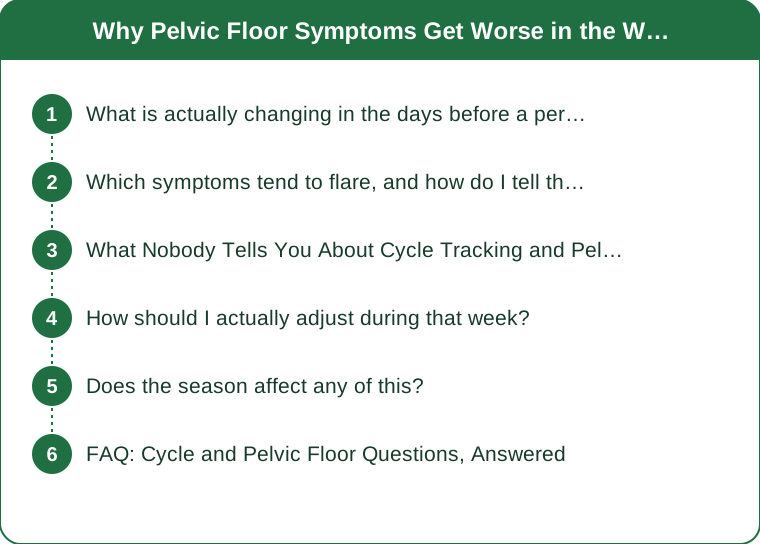
What is actually changing in the days before a period?
Four things, roughly at once, and they all push in the same direction.
Progesterone is high through the luteal phase, then falls sharply just before menstruation. Progesterone relaxes smooth muscle throughout the body — which is why digestion slows and why many people experience urinary changes — and it also affects connective tissue laxity. A pelvic floor operating in a more relaxed tissue environment provides less support at the same level of strength.
Fluid retention increases. Premenstrual fluid shifts are common, and the additional volume increases pressure within the abdomen and pelvis. More downward pressure on the same supporting structures means symptoms appear at a lower threshold of activity.
Prostaglandins rise before menstruation. These are the compounds that drive uterine contractions and much of period pain. They also contribute to increased pelvic sensitivity and can cause referred discomfort in the surrounding structures.
Pain sensitivity itself changes. Research on pain perception across the menstrual cycle suggests thresholds vary, and many people report being more sensitive in the late luteal and early menstrual phases. So the same amount of tissue stress can be experienced as more symptomatic, independently of anything structural changing.
Add the everyday accompaniments — constipation is common premenstrually, and straining is one of the most direct sources of pelvic floor load — and the picture is fairly complete.
Does this mean my exercises are not working?
No. It means you are measuring them during the week when the underlying conditions are least favourable. Compare like with like: this month’s late luteal phase against last month’s, rather than against your best week.
Which symptoms tend to flare, and how do I tell them apart?
The common ones, and what each usually points to:
Increased urinary urgency or frequency. Very commonly reported premenstrually. Progesterone’s effect on smooth muscle and increased pelvic pressure both contribute. Usually resolves within a day or two of the period starting.
Leaking with coughing, sneezing or exercise that did not leak last week. This is the one people find most discouraging. It reflects the combination of tissue laxity and increased downward pressure rather than a loss of strength.
A feeling of heaviness or dragging. Often reported as worse toward the end of the day and worse premenstrually. Fluid retention and tissue laxity both contribute.
Increased pelvic or lower back aching. Frequently prostaglandin-related and often accompanies period pain.
Pain with intercourse or with tampon insertion. Can increase premenstrually, and this one is more often associated with pelvic floor tension rather than weakness — an important distinction, because the treatments are opposite.
Constipation and the straining that follows it. This is the most actionable item on the list and it is worth treating directly, because straining loads the pelvic floor more than most exercise does.
What is worth flagging to a professional rather than managing at home: symptoms that do not improve when the period starts, symptoms that are getting worse cycle on cycle, any new pain, or a visible or felt bulge. Also anything involving bowel control, which people delay raising far too long and which responds well to treatment.
This is general information, not medical advice. Pelvic health physiotherapy is highly effective and worth seeking rather than managing alone.
What Nobody Tells You About Cycle Tracking and Pelvic Health
The improvement is real even when it disappears for a week. Progress in pelvic floor rehabilitation is not linear, and cyclical variation is superimposed on top of it. Plotting symptoms against cycle day rather than against calendar date makes the underlying trend visible, and it is frequently better than people believe.
Most programmes are abandoned in the late luteal phase. It is the week when symptoms look worst and effort feels least rewarded. Knowing that in advance is genuinely protective.
More effort is not the answer during a flare. The instinct is to do more exercises when symptoms worsen. If any part of the picture involves pelvic floor tension rather than weakness — and it often does — additional contraction work makes it worse. A tight pelvic floor and a weak one produce overlapping symptoms, which is the single most common reason home programmes fail.
Constipation is a bigger factor than exercise. A few days of straining undoes more than a few days of skipped exercises. Fibre, fluid, and a footstool that raises the knees above the hips are all low-effort and high-return during this week.
High-impact training in this window has a higher cost. Not forbidden, and worth adjusting. Many people find that swapping one running session for something lower-impact during the flare week reduces symptoms without affecting fitness at all.
Caffeine and pelvic floor symptoms interact. Caffeine is a bladder irritant and increases urgency in many people. Reducing it specifically during the flare week is a small change that some people find disproportionately effective.
And the piece that is rarely said: breathing pattern matters as much as contraction. The pelvic floor moves with the diaphragm on every breath. Bracing and breath-holding during exertion drives pressure downward, and it is a habit most people have without knowing it. Exhale on the effort is the most useful single cue in the whole field.

How should I actually adjust during that week?
The aim is to reduce load without stopping, and to protect the habit through the low-return days.
- Keep doing your programme, but judge it by consistency rather than by how it feels. This is the week the habit is at risk.
- Exhale on exertion, every time. Lifting, standing from a chair, coughing if you can anticipate it.
- Swap one or two high-impact sessions for lower-impact equivalents. Cycling, swimming, walking or strength work with controlled breathing all maintain fitness with less downward pressure.
- Treat constipation actively. Fibre, fluid, and a footstool. Do not strain — if it is not happening, get up and try later.
- Consider reducing caffeine for those days if urgency is your main symptom.
- Elevate your feet for ten minutes in the evening if heaviness is the main symptom. It helps fluid distribution and it costs nothing.
- Track it. Note symptoms against cycle day for two or three months. The pattern usually becomes obvious, and it converts an unpredictable problem into a predictable one you can plan around.
And if you are working with a pelvic health physiotherapist, tell them about the cyclical pattern. It is clinically useful information and it may change what they recommend for that week specifically.
What if I am not sure whether my issue is weakness or tension?
That is exactly what an assessment is for, and it cannot reliably be determined at home. Symptoms overlap almost completely, and the programmes are close to opposites. This is the highest-value reason to see someone.
Does the season affect any of this?
Less directly than the cycle does, but a few things are worth knowing as autumn arrives.
Constipation often increases as the weather cools, largely because people drink less water when it is not hot and because activity levels drop. Since straining is one of the most direct pelvic floor loads, this is a real and preventable seasonal factor. Keep fluid intake up even when you do not feel thirsty.
Cold weather increases urinary urgency for many people. This is normal physiology — cold causes peripheral vasoconstriction and increases urine production — and it can look like a worsening of symptoms when it is a temperature response.
Coughs and colds arrive. A two-week cough produces hundreds of forceful downward pressure events, and it is a genuinely common trigger for a symptom flare in people who were doing well. Crossing your legs and leaning slightly forward when you cough reduces the load, and it is worth making automatic before the season starts.
Training shifts indoors and often gets more repetitive, which can concentrate loading patterns.
And activity levels drop overall, which affects general strength and circulation. Keeping walking volume up through autumn is one of the more useful background habits for pelvic health.
The practical version: over the next few weeks, keep fluid up, get ahead of constipation, and learn the cough brace now rather than during the first bad cold.
This is general information, not medical advice — see a doctor or pelvic health physiotherapist for symptoms that persist or worsen.
FAQ: Cycle and Pelvic Floor Questions, Answered
Should I stop exercising during the flare week?
No. Adjust intensity and impact rather than stopping. Consistency across months matters more than intensity in any given week.
Does this happen to everyone?
No. Cyclical variation is common and far from universal, and its size varies a lot. If you do not notice it, that is entirely normal too.
Does hormonal contraception change the pattern?
It can. Methods that suppress ovulation produce a flatter hormonal profile, and some people find the cyclical variation reduces considerably. Worth discussing with your doctor.
What about perimenopause?
Hormonal fluctuation becomes less predictable, and falling oestrogen affects the tissues of the pelvic floor and urethra directly. Symptoms often change in this period, and it is a good reason to seek assessment rather than assume it is inevitable.
How long should a programme take to work?
Most pelvic floor strengthening programmes need a minimum of three months of consistent work before a fair judgement, and improvements often continue well beyond that.
TL;DR:
- Symptoms commonly worsen in the late luteal phase — the days before a period — for hormonal reasons.
- Progesterone relaxes connective tissue, fluid retention raises pelvic pressure, prostaglandins rise, and pain sensitivity shifts.
- This is not lost progress. Compare this month’s flare week to last month’s, not to your best week.
- More exercises is the wrong response if any of the problem is tension rather than weakness — and the symptoms overlap almost completely.
- Constipation and straining load the pelvic floor more than most exercise, so treat it actively that week.
- Exhale on exertion, always. It is the highest-value cue in the field.
- Autumn brings less fluid intake, more constipation and cough season — learn the cough brace now.
This is general information, not medical advice.
The programme is probably working. You have just been judging it during the five days it was always going to look worst.
Keep Reading
This article is for general informational purposes only and is not medical advice. Always consult a qualified health professional for guidance specific to you.