Why Breath Holding Loads Your Pelvic Floor More Than Jumping
Quick Answer: Your diaphragm and pelvic floor work as the top and bottom of a pressurized canister. When you hold your breath and strain — lifting a toddler, standing up with the laundry, wrestling a stuck window — you seal the top and squeeze the middle, and the pressure spike drives straight down onto the pelvic floor. A single jump produces a brief, prepared impact; a braced breath-hold produces a longer, larger, unprepared one, dozens of times a day. Exhaling through the effort vents the pressure, which is why the cue ‘blow before you go’ changes symptoms faster than avoiding impact ever did.
This is general information, not medical advice — a pelvic health physical therapist is the right partner for persistent symptoms.

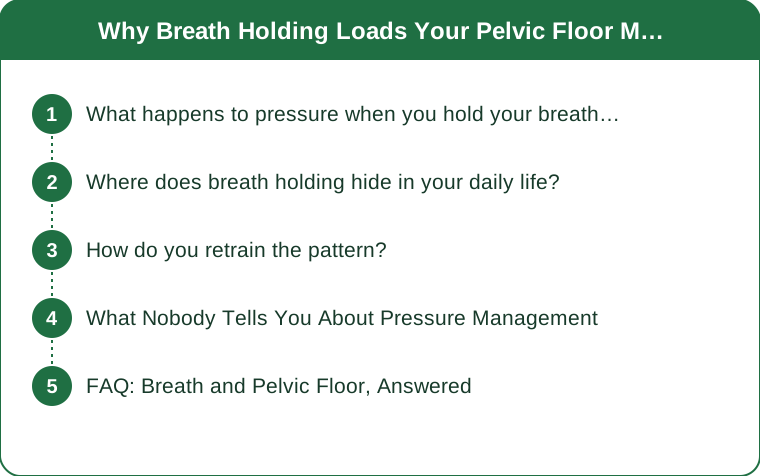
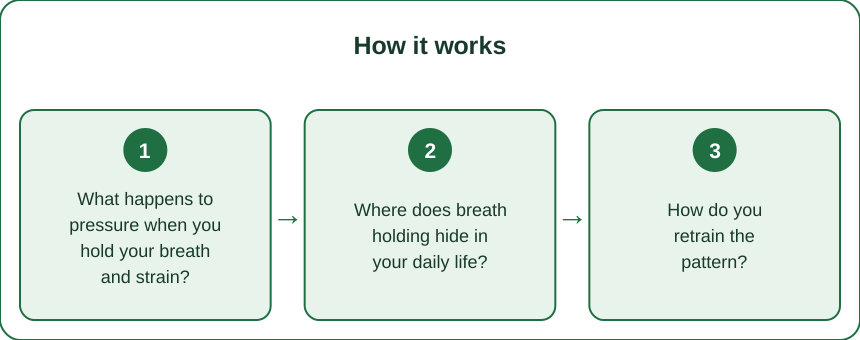
What happens to pressure when you hold your breath and strain?
Picture your torso as a sealed canister. The diaphragm is the lid, the pelvic floor is the base, and your abdominal wall wraps the sides.
When you inhale deeply and hold, the lid clamps shut against a closed throat. When you then exert — lift, push, strain — your abdominal muscles squeeze the sealed canister. Pressure inside rises sharply, and pressure goes wherever the walls yield most. The ribcage is bone. The clamped diaphragm is not moving. That leaves the abdominal wall and the pelvic floor, and gravity is already voting for the floor.
This maneuver has a name — the Valsalva — and it exists because it works: sealing the canister stiffens your trunk impressively, which is exactly why your body reaches for it when something feels heavy. The strength is real. The bill is delivered downward.
Compare the jump everyone fears. Landing sends a brief force spike through a pelvic floor that saw it coming — the reflexive pre-tightening before impact is automatic in most bodies. The breath-hold strain is longer in duration, arrives without the reflex, and repeats far more often than anyone jumps.
The math of a normal day: a couple of jumps, maybe — and thirty to fifty braced breath-holds nobody counted. If symptoms seem unrelated to exercise, this is usually the missing ledger.
Where does breath holding hide in your daily life?
Everywhere effort lives, including places with no weight at all.
The lifting cluster is obvious once named: the car seat out of the back seat, the toddler off the floor, the laundry basket, the grocery haul in one trip, the suitcase into the overhead. Each one starts with an unconscious gulp of air and a clamp.
The transition cluster is sneakier. Standing up from a low couch. Getting out of bed by sitting straight up. Rising from the toilet. These feel like nothing, but low, deep positions plus effort recruit the same brace — and they repeat dozens of times daily.
The bathroom cluster matters most. Straining against constipation is the highest-pressure, longest-duration event on the list, and managing it — fiber, fluids, a footstool, unhurried timing — is quietly one of the most effective pelvic floor interventions available.
And the stress cluster surprises everyone: typing an difficult email, parallel parking, opening a stubborn jar, even blow-drying hair with arms overhead. Concentration and low-grade stress produce shallow breathing punctuated by holds, each a small pressure event.
A useful audit: for one day, notice every time you exhale audibly after an effort — that sigh of release is the receipt for a hold that already happened. Most people stop counting before lunch, which is precisely the point.

How do you retrain the pattern?
One rule, practiced until it is boring: exhale through the effort.
Start with ‘blow before you go.’ Just before the hard part of any task — the lift-off, the stand-up, the push — begin a slow exhale through pursed lips, and let the effort ride on the breath. Exhaling keeps the throat open and the diaphragm moving upward, which vents the canister while your deep abdominals still engage. You keep most of the stability and lose most of the downward spike.
Rebuild the big five. Pick your five most repeated efforts — car seat, standing from the couch, laundry, toddler, stairs with bags — and deliberately rehearse the exhale version of each a few times. Habits attach to specific movements far faster than to general intentions.
Talk or count out loud during exertion. Speech is a forced exhale — you physically cannot Valsalva mid-sentence. Counting reps out loud, or narrating to the baby, is a pressure-management technique disguised as personality.
Learn the difference between bracing and bearing down. A good brace feels like gentle tension wrapping the waist, breath still flowing. Bearing down feels like pushing toward the floor, breath stopped. If you cannot tell them apart from the inside, that distinction alone is worth a session with a pelvic health physical therapist.
Expect the retrain to take a few weeks of feeling deliberate, and expect it to matter more than any single exercise you add — this is subtraction of load, forty times a day.
What Nobody Tells You About Pressure Management
Kegels are not the universal answer. A pelvic floor can be weak, or it can be tight and overworked — and a clenched, never-resting floor responds badly to more clenching. If squeezing makes symptoms worse, that is information, and a pelvic health PT visit beats another month of guessing.
Tight ≠ strong. A floor that never relaxes cannot generate force when it is actually needed, the way a fist clenched all day cannot punch. Full breaths that let the belly and floor soften on the inhale are half of the training, not a break from it.
Very tight waistbands change the pressure map. Deep compression shapewear — and leggings with an aggressively rigid waistband — can redirect strain downward when pressure spikes, because the squeezed abdomen cannot expand outward. Comfortably supportive high-waisted leggings that you can breathe into a full belly against are fine; the garment you have to hold your breath to close is telling you something.
Symptoms during jumping often start at the breath. Many people leak or feel heaviness on a trampoline not because of impact itself but because they hold their breath the entire time they bounce. Exhaling rhythmically while jumping changes the experience for a surprising share — worth testing gently before writing off impact forever.
Pressure habits follow you into the gym. The same person who exhales beautifully through a squat set will Valsalva picking the plates off the rack. The transitions between exercises are unsupervised reps too.
FAQ: Breath and Pelvic Floor, Answered
Is holding my breath ever okay?
For healthy, symptom-free lifters, a brief brace under a genuinely heavy barbell is a normal technique used deliberately. The problem is the unconscious version applied to laundry — maximal strategy, minimal load, forty times a day. Match the strategy to the demand.
I exhale but still feel downward pressure. Now what?
Check whether the exhale is real — many people let air out while still pushing down beneath it. Try humming or a slow hiss instead, which keeps the airway honestly open. If heaviness persists, that is a clear cue to see a pelvic health physical therapist rather than to keep self-adjusting.
Does this matter if I have no symptoms?
Yes, as prevention priced at zero. Pressure habits are far easier to build before symptoms than to rebuild after, and the exhale habit also improves lifting mechanics generally.
How long until daily-life changes show up in symptoms?
When breath holding is a main driver, people often notice a difference in two to four weeks of consistent exhale-on-effort. Slower or no change means other factors are in play — muscle coordination, tissue, hormones — which is exactly what a professional assessment sorts out.
This is general information, not medical advice. Persistent leaking, heaviness, or pelvic pain deserves a proper assessment — pelvic health physical therapy is the front door.
TL;DR:
- Diaphragm and pelvic floor are the lid and base of a pressure canister; a breath-hold plus effort spikes pressure straight downward.
- A normal day contains thirty-plus braced holds — car seats, couches, jars, emails — versus a handful of jumps. The holds are the bigger ledger.
- Retrain with ‘blow before you go’: exhale through every effort, rehearse your five most repeated lifts, talk or count out loud.
- Kegels are not automatically the answer; a tight floor needs relaxing, and a pelvic health PT settles which kind yours is.
Run the one-day audit tomorrow: count the after-effort sighs. Most people find the real training program hiding in their laundry room, and it starts with one deliberate exhale.
This is general information, not medical advice.
See It in Motion
Seen here: High Waist Yoga Leggings with Side Pockets — shop it on bubblelime.com
Keep Reading
This article is for general informational purposes only and is not medical advice. Always consult a qualified health professional for guidance specific to you.