Why Coughing or Sneezing Leaks Happen Even With Strong Pelvic Floor Muscles
Quick Answer: A cough or sneeze happens faster than a consciously-triggered pelvic floor contraction can respond — the muscles can be strong overall and still leak if they’re not contracting with the right timing, which is a coordination issue as much as a strength one.
You’ve done the strengthening work. Your pelvic floor tests strong. And yet a hard sneeze still causes a leak. That contradiction is common, and it points to something Kegels alone don’t always fix: timing, not just strength.

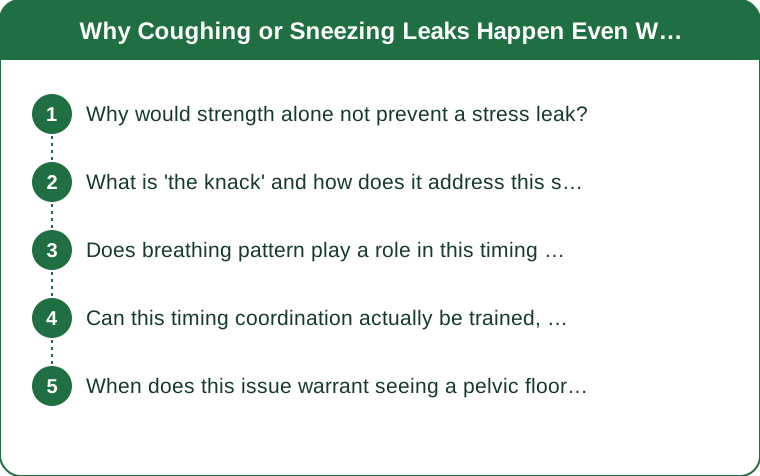
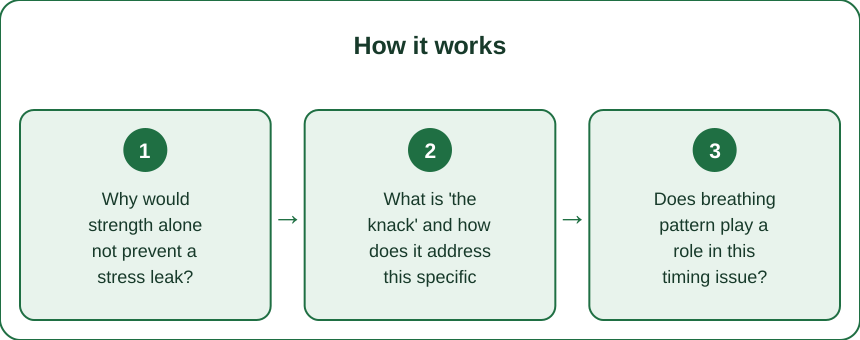
Why would strength alone not prevent a stress leak?
A cough or sneeze creates a sudden spike in intra-abdominal pressure that happens in a fraction of a second — faster than many people can consciously initiate a pelvic floor contraction. A muscle can be strong in a controlled, planned contraction (like a Kegel) and still fail to contract quickly enough for an involuntary reflex like a sneeze, which is fundamentally a timing and coordination issue layered on top of raw strength.
What is ‘the knack’ and how does it address this specific timing gap?
‘The knack’ is a technique where you consciously pre-contract the pelvic floor right before a predictable pressure event — right before you cough, sneeze, or lift something heavy — rather than trying to react after the pressure spike has already started. Practicing this timing specifically, not just general strengthening, targets the exact gap that causes leaks despite adequate strength.

Does breathing pattern play a role in this timing issue?
Yes — holding your breath or bracing incorrectly during a cough or sudden movement can actually increase downward pressure on the pelvic floor rather than supporting it. Coordinating an exhale with the pelvic floor contraction, rather than a breath-hold, tends to work with the pressure system instead of against it.
Can this timing coordination actually be trained, or is it just about the moment itself?
It can be trained — practicing the pre-contraction (‘the knack’) deliberately during predictable moments (before a planned cough, before standing up, before a known trigger) builds the reflex-like timing over repetition, similar to how any motor skill improves with practice, not just isolated strength work.
When does this issue warrant seeing a pelvic floor physical therapist rather than self-practicing?
If leaks persist despite consistent strengthening and knack practice over several weeks, or if leaking happens with minimal exertion, a pelvic floor physical therapist can assess the specific coordination pattern directly and provide more targeted, individualized guidance than general exercises alone.
TL;DR:
- Sudden pressure events like coughs move faster than an unpracticed pelvic floor contraction
- Strength alone doesn’t guarantee the right timing of contraction
- “The knack” — pre-contracting right before a known trigger — targets this specific gap
- Coordinating exhale with contraction works with pressure dynamics rather than against them
This is general information, not medical advice — persistent leaking despite strengthening work is a good reason to see a pelvic floor physical therapist rather than assuming more Kegels alone will fix it.
Keep Reading
This article is for general informational purposes only and is not medical advice. Always consult a qualified health professional for guidance specific to you.