Why Jumping Jacks Are Actually a Real Test of Pelvic Floor Function
Quick Answer: Jumping jacks combine repetitive impact loading with a need for rapid pelvic floor muscle coordination to manage the downward force of each landing, which is a more demanding combination than most low-impact exercises test — this is why leakage or heaviness during jumping jacks specifically often surfaces pelvic floor coordination issues that walking or gentle strength training don’t reveal.
If jumping jacks specifically cause symptoms that other exercises don’t, that’s a meaningful, specific signal worth paying attention to.
This is general information, not medical advice — a pelvic floor physical therapist can properly assess and address specific symptoms.

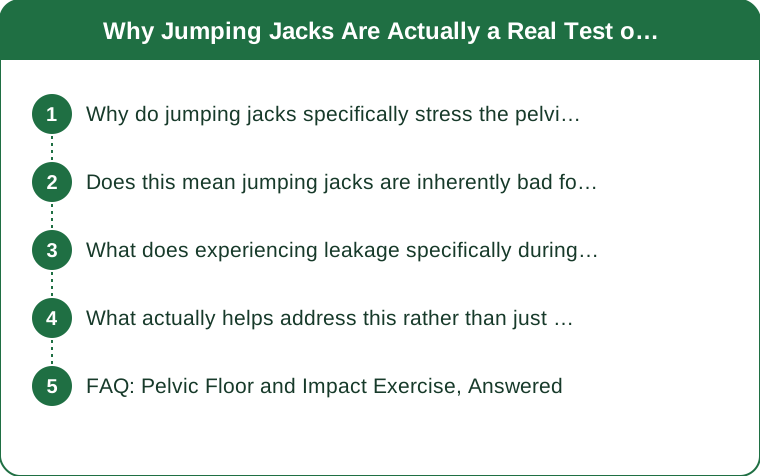
Why do jumping jacks specifically stress the pelvic floor more than other cardio moves?
Repetitive impact landing requires the pelvic floor to rapidly contract and manage downward force with each jump, at a faster tempo and higher repeated load than walking or most low-impact cardio, exposing coordination gaps that gentler movement doesn’t test.
Does this mean jumping jacks are inherently bad for pelvic floor health?
No — for a well-functioning pelvic floor, jumping jacks are a completely normal, safe movement. Symptoms during them specifically are a useful diagnostic signal, not evidence the exercise itself is harmful in general.

What does experiencing leakage specifically during jumping, but not other exercise, actually suggest?
It often suggests the pelvic floor can manage sustained, lower-demand loads but struggles with the rapid, repetitive coordination jumping requires — a specific, addressable coordination and timing issue rather than a general strength problem alone.
What actually helps address this rather than just avoiding jumping exercises indefinitely?
Pelvic floor physical therapy focused specifically on coordination and timing under impact, not just general strengthening exercises, tends to address this more directly, since the issue is often about timing and coordination as much as raw strength.
FAQ: Pelvic Floor and Impact Exercise, Answered
Should I stop doing jumping jacks entirely if I notice symptoms?
Modifying to lower-impact alternatives temporarily while addressing the underlying issue is often more useful than permanently avoiding all impact exercise.
Is this issue more common after childbirth specifically?
Yes, pelvic floor coordination changes are common after childbirth, though the issue can occur in other contexts too.
Can general core strengthening alone fix this without dedicated pelvic floor work?
General core work helps but often isn’t sufficient alone — dedicated pelvic floor coordination training addresses the specific mechanism more directly.
TL;DR:
- Jumping jacks demand rapid pelvic floor coordination that gentler exercise doesn’t test
- Symptoms specifically during jumping point to a coordination issue, not exercise being harmful
- This pattern is a useful diagnostic signal worth addressing rather than just avoiding
- Pelvic floor physical therapy targeting coordination, not just strength, is the more direct fix
- This is general information, not medical advice — a pelvic floor specialist can properly assess your situation
Keep Reading
This article is for general informational purposes only and is not medical advice. Always consult a qualified health professional for guidance specific to you.