Why Pelvic Floor Symptoms Get Worse Later in the Day
Quick Answer: Pelvic floor muscles fatigue over a day the same way any postural muscle does, and gravity loads them for every upright hour. By late afternoon the muscles are tired, intra-abdominal pressure has been elevated for hours, and fluid has shifted downward - so symptoms that were absent at 9 a.m. appear at 4 p.m. The most effective responses are timing-based: a mid-day horizontal break, breaking up long standing or sitting blocks, and moving your pelvic floor work to the morning when the muscles can actually perform it.
This pattern is common enough that its absence is more notable than its presence.
And it changes what the right intervention is, because a fatigued muscle and a weak muscle need opposite things. This is general information, not medical advice.

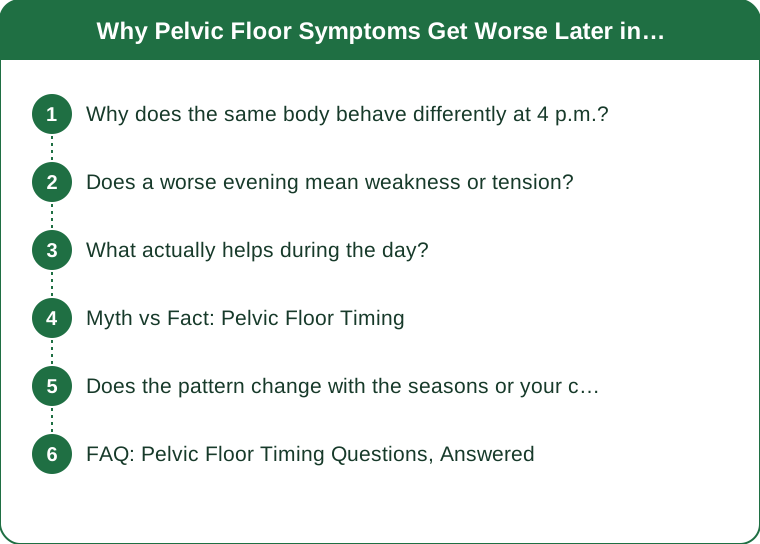
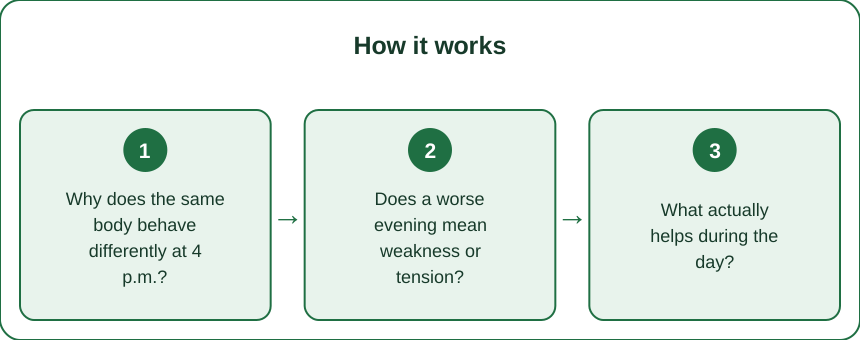
Why does the same body behave differently at 4 p.m.?
Three things accumulate across a day, and they compound.
Muscular fatigue. The pelvic floor holds a low-level contraction whenever you are upright - it is a postural muscle group with a continuous job. Sustained low-level activation is unusually fatiguing, and unlike your biceps, these muscles rarely get a period of full relaxation during waking hours.
Accumulated intra-abdominal pressure. Every cough, lift, laugh, and forward bend pushes downward. The load is not one big event; it is hundreds of small ones, and the tissue’s ability to respond degrades across the day.
Fluid shift. Standing and sitting move fluid toward the lower body over hours. This contributes to a sensation of heaviness and pressure that is genuinely absent in the morning, when a night of lying flat has redistributed it.
Which is why the morning feels normal. Seven or eight hours horizontal completely unloads the system - the muscles rest, the pressure drops, and the fluid returns. You are not imagining that mornings are easier; you have just come off the only real recovery period the pelvic floor gets.
Does a worse evening mean weakness or tension?
This is the question that determines what you should actually do, and the answers point in opposite directions.
If symptoms are worse in the evening and better after rest, fatigue is the likely driver. A fatigued muscle needs recovery and better pacing, not more repetitions.
If symptoms are worse in the evening and also worse after you do pelvic floor exercises, tension is more likely. An overactive pelvic floor produces the same symptoms as a weak one - urgency, leaking, pressure, discomfort - and Kegels make it worse. This is one of the most consequential distinctions in the whole topic, and it is frequently missed.
Tension signs to look for: difficulty fully relaxing, discomfort with sitting for long periods, a sense of never quite letting go, symptoms that flare with stress, and no improvement after weeks of diligent strengthening.
Fatigue signs: clear time-of-day pattern, improvement with rest, and improvement over a period of consistent, moderate training.
If eight weeks of strengthening has produced nothing or made things worse, stop and get assessed by a pelvic health physical therapist. More effort against the wrong diagnosis is the most common way people spend a year going backwards. This is general information, not medical advice.
What actually helps during the day?
Timing beats effort here, and most of these cost nothing.
Take one horizontal break. Ten to fifteen minutes lying down with your hips slightly elevated, ideally in the early afternoon before symptoms start. This directly unloads the muscles and reverses the fluid shift - it is the single highest-value intervention and it works precisely because it is preventive.
Break up long blocks. Both prolonged standing and prolonged sitting are problems, and the fix is alternation. Change position every 30-45 minutes.
Do your pelvic floor exercises in the morning. A fatigued muscle cannot execute a good contraction, so evening practice trains a poor pattern. Morning work, on rested tissue, is measurably better quality.
Exhale on effort. Lifting, standing from a chair, picking up a child - breathe out as you exert. Holding your breath spikes intra-abdominal pressure exactly when the floor is least able to handle it.
Do not strain on the toilet, and do not hover. Both raise pressure substantially. Feet on a small stool, knees above hips, and let gravity do the work.
And stop the just-in-case bathroom trips. Emptying at low volumes teaches the bladder to signal earlier and earlier, which makes evening urgency worse over weeks.

Myth vs Fact: Pelvic Floor Timing
Myth: More Kegels always means fewer symptoms. Fact: if the underlying problem is an overactive floor, more contractions worsen it. Symptoms getting worse with diligent practice is meaningful information, not a sign you need to try harder.
Myth: Symptoms that only appear in the evening are not serious. Fact: a time-of-day pattern tells you about the mechanism, not the severity. It is a very treatable pattern - which is a different thing from an unimportant one.
Myth: You should do pelvic floor exercises whenever you remember. Fact: quality of contraction beats quantity, and quality is far higher on rested muscle. A short, well-executed morning set outperforms scattered evening repetitions.
Myth: Lying down during the day is giving in. Fact: it is the most direct way to unload a postural muscle group and shift fluid back. Fifteen minutes of horizontal is a legitimate intervention, not a lack of discipline.
Myth: Only people who have given birth get this. Fact: pelvic floor symptoms occur across a wide range of people, including those who have never been pregnant. Chronic coughing, constipation, heavy lifting, high-impact sport, and prolonged standing all load the same system.
Does the pattern change with the seasons or your cycle?
Both, and knowing it prevents a lot of unnecessary alarm.
Across the menstrual cycle, many people notice symptoms shift - often with more pressure and heaviness in the premenstrual phase. Hormonal changes affect connective tissue and fluid retention. A bad week that resolves is a pattern; a bad week that keeps extending is worth investigating.
In late summer, heat drives fluid retention and swelling, and dehydration concentrates urine, which irritates the bladder and worsens urgency. Drinking less to reduce trips reliably backfires - concentrated urine is more irritating, not less.
As fall arrives, two things change. Cold-weather coughs and seasonal allergies mean repeated pressure spikes, and a persistent cough is a genuine and under-recognized aggravator. If allergy season reliably worsens your symptoms, treating the cough is treating the pelvic floor.
And activity patterns change. Summer walking becomes fall running or an indoor class, and an abrupt jump in impact volume is a classic trigger. Build back gradually rather than resuming at last spring’s level.
One more seasonal factor: constipation rises when fluid intake drops in cooler weather. Straining is one of the highest-pressure events the pelvic floor experiences, and it is largely preventable with fluid and fiber.
FAQ: Pelvic Floor Timing Questions, Answered
Should I stop exercising if symptoms are worse in the evening?
No - but shift the harder sessions earlier in the day when possible, and watch for leaking as a signal to reduce impact rather than to push through. Strength training in general is helpful; repeated high-impact work on a fatigued floor is not.
How long should I lie down for it to help?
Ten to fifteen minutes is enough for most people, with hips level or slightly elevated. Do it before symptoms appear - preventive timing works far better than a response after the fact.
When should I see someone about this?
If symptoms are worsening, if there is pain, if you feel a bulge, or if eight weeks of consistent effort has produced no improvement. A pelvic health physical therapist can assess whether you are dealing with weakness or tension, which is the question you cannot reliably answer alone. This is general information, not medical advice.
TL;DR:
- The evening pattern is fatigue plus accumulated pressure plus fluid shift - not something you did wrong that afternoon.
- A mid-day horizontal break of 10-15 minutes is the highest-value intervention, and it works preventively.
- Do pelvic floor work in the morning, when the muscles can actually produce a quality contraction.
- If strengthening makes things worse, suspect tension rather than weakness and get assessed.
- Exhale on effort, do not strain, and skip the just-in-case bathroom trips.
Try the afternoon horizontal break for one week before you change anything else. If your evenings improve, you have learned more about the mechanism than any amount of extra effort would have taught you. This is general information, not medical advice.
Keep Reading
This article is for general informational purposes only and is not medical advice. Always consult a qualified health professional for guidance specific to you.