Why Pelvic Floor Tightness Can Cause the Exact Same Symptoms as Weakness
Quick Answer: A pelvic floor that’s chronically tight or overactive can produce leakage, pressure, and discomfort symptoms that look identical to classic weakness symptoms, because a muscle that’s already tense has less additional contracting range available when it’s actually needed (like during a cough or sneeze) — meaning the standard advice to simply ‘do more Kegels’ can worsen symptoms if tightness, not weakness, is the actual underlying cause.
Same symptoms, opposite underlying cause. That’s why generic pelvic floor advice sometimes makes things worse instead of better.

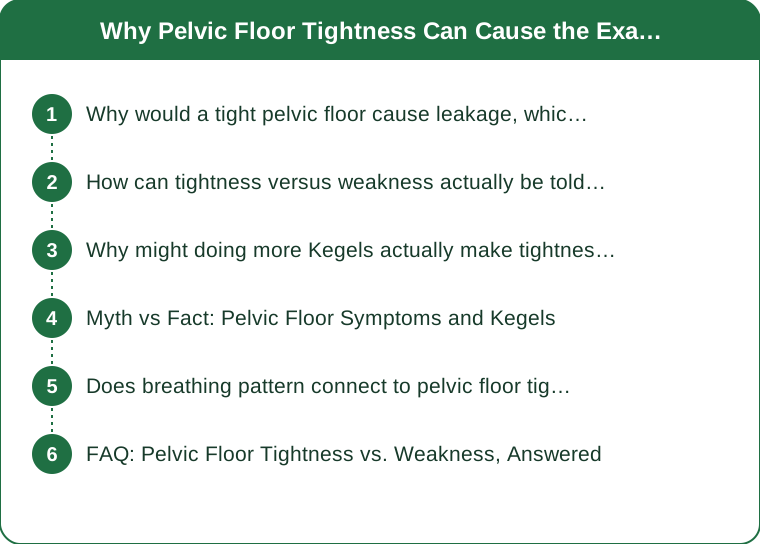
Why would a tight pelvic floor cause leakage, which sounds like a weakness problem?
A pelvic floor muscle that’s already held in a chronically tense, shortened state has less remaining ability to generate an additional, quick contraction exactly when one is needed (a sudden cough, sneeze, or jump), similar to how an already-clenched fist can’t squeeze meaningfully tighter on demand — the functional result can look identical to weakness-based leakage even though the underlying muscle state is essentially opposite.
How can tightness versus weakness actually be told apart without professional assessment?
Self-assessment is genuinely difficult and often unreliable, which is exactly why a pelvic floor physical therapist’s hands-on internal assessment is considered the most accurate way to distinguish the two — some general clues (a sense of pelvic tension, pain during certain positions, or symptoms that worsen with more Kegel practice rather than improving) suggest tightness may be involved, but a proper assessment remains the reliable standard.
Why might doing more Kegels actually make tightness-related symptoms worse, not better?
Kegels train the pelvic floor to contract further, which is the wrong direction of training entirely if the muscle is already chronically over-contracted — for a tightness-based issue, relaxation and lengthening exercises are generally the appropriate approach, meaning generic ‘more Kegels’ advice can meaningfully worsen an overactive pelvic floor rather than helping it.

Myth vs Fact: Pelvic Floor Symptoms and Kegels
Myth: any pelvic floor symptom (leakage, pressure, discomfort) should be treated with Kegel exercises by default. Fact: Kegels are appropriate specifically for weakness-based dysfunction, and can worsen tightness-based dysfunction — professional assessment to identify which type is present is the necessary first step before choosing an exercise approach.
Does breathing pattern connect to pelvic floor tightness in a meaningful way?
Yes — the pelvic floor and diaphragm work together in a coordinated breathing pattern, and chronic shallow chest breathing or habitually holding tension in the abdomen can contribute to pelvic floor overactivity over time, making diaphragmatic breathing practice a common component of treatment for tightness-related pelvic floor dysfunction.
FAQ: Pelvic Floor Tightness vs. Weakness, Answered
Can someone have both tightness and weakness in different parts of the pelvic floor at once?
Yes — mixed presentations are common and part of why professional assessment matters, since a generic one-size approach (either all-Kegels or all-relaxation) may not address a genuinely mixed picture correctly.
What does pelvic floor relaxation training typically involve if tightness is the issue?
Diaphragmatic breathing practice, specific stretches (like child’s pose or deep squat holds), and guided relaxation techniques taught by a pelvic floor physical therapist are common components.
Is pain during intimacy a sign that points more toward tightness than weakness?
It can be a relevant symptom worth mentioning to a pelvic floor specialist, though it isn’t diagnostic on its own — a proper assessment remains the reliable way to determine the underlying cause.
This is general information, not medical advice. Pelvic floor symptoms are worth discussing with a pelvic floor physical therapist or your healthcare provider for proper assessment.
TL;DR:
- A chronically tight pelvic floor can produce leakage symptoms that look identical to classic weakness symptoms
- An already-tense muscle has less available range to contract further exactly when it’s needed most
- Generic Kegel advice can worsen symptoms if the actual underlying issue is tightness, not weakness
- Professional hands-on assessment is the reliable way to tell the two apart before choosing an exercise approach
If Kegels haven’t helped, or symptoms have gotten worse with them, that’s worth raising with a pelvic floor specialist — tightness, not weakness, may be the actual cause.
Keep Reading
This article is for general informational purposes only and is not medical advice. Always consult a qualified health professional for guidance specific to you.