Why Running Surface Changes Pelvic Floor Load More Than Distance
Quick Answer: Ground reaction force is what loads the pelvic floor during running, and surface hardness, running speed, and stride mechanics change that force far more than the total distance does. A run of the same length on concrete produces a different loading pattern than one on grass or a treadmill. This is why people who have been fine for months suddenly start leaking after changing routes, and why the fix is often a surface or cadence change rather than more pelvic floor exercises. Symptoms that persist deserve assessment by a pelvic health physiotherapist.
You have been running the same distance for months with no problem. Then you switch to a new route, or the weather pushes you onto pavement, and within two weeks something has changed.
The usual conclusion is that your pelvic floor has got weaker. Far more often, the load on it went up while nothing about you changed at all.

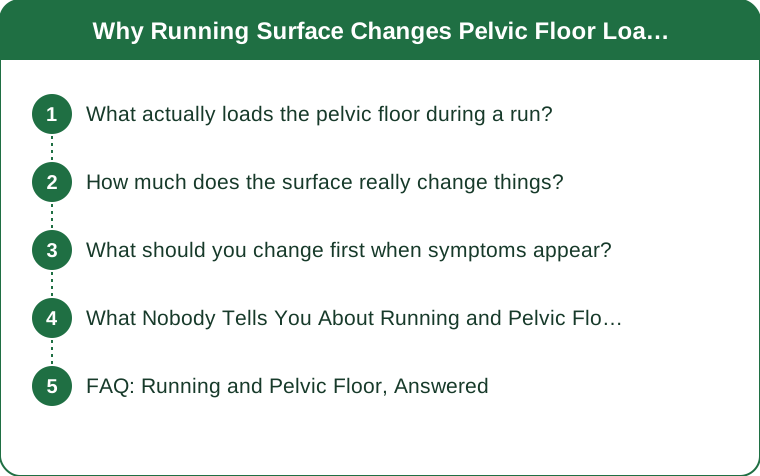
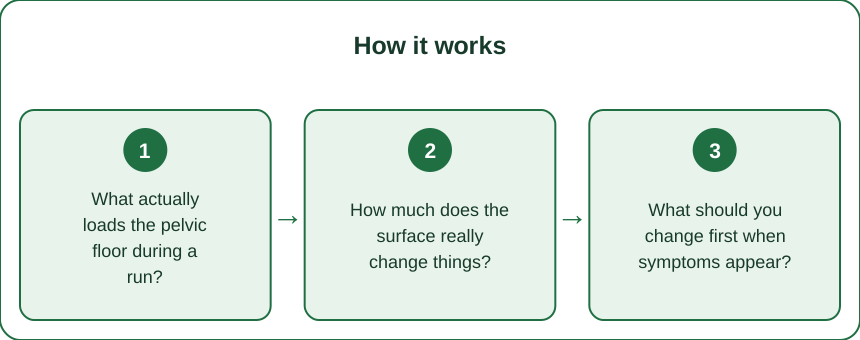
What actually loads the pelvic floor during a run?
Impact force travelling up through the body, and how much of it arrives depends on more than distance.
Ground reaction force is the primary input. Every footstrike sends force up through the leg, and the pelvic floor is part of the system that manages the resulting pressure. Running produces ground reaction forces of roughly two to three times body weight per step, compared to about one to one and a half times for walking.
Intra-abdominal pressure is what the pelvic floor actually resists. The impact combines with breathing and trunk bracing to create pressure inside the abdomen, and the pelvic floor forms the bottom of that container. When the downward pressure exceeds what the floor can counter in that instant, symptoms appear.
Timing matters as much as magnitude. The pelvic floor should co-contract reflexively, slightly ahead of the impact. Fatigue, poor breathing coordination, and disrupted timing all reduce how well that happens, which is why symptoms typically appear later in a run rather than in the first mile.
Which is why distance is a misleading variable. Adding a mile adds repetitions of a load. Changing surface, speed, or stride changes the size of each load. A modest increase in per-step force applied over the same number of steps is a much bigger change in total than adding ten percent more steps at the same force.
This blog has covered the related mechanisms separately, including why breathing needs fixing before anything else and why symptoms show up later in the day. Both interact directly with what follows here.
How much does the surface really change things?
Enough to explain most sudden changes in symptoms, and not in the simple way people assume.
Harder surfaces do not automatically mean higher impact force. This is the counterintuitive part. Research consistently finds that runners adjust their leg stiffness to the surface, landing more softly on hard ground and more firmly on soft ground, so peak ground reaction force is often surprisingly similar across surfaces.
What does change is the loading rate and the consistency. On hard, even pavement, every step is nearly identical, so the same tissues receive the same load thousands of times without variation. On a trail or grass, the surface is uneven, stride length varies, and the loading is distributed across slightly different patterns and different muscles with every step.
Repetitive identical loading is the specific problem. For the pelvic floor, as for bone and tendon, a varied load pattern allows partial recovery between similar loads. Identical repetition does not. This is why the pavement runner develops symptoms and the trail runner covering the same distance frequently does not.
Camber matters and is invisible. Roads are built with a slope for drainage. Running consistently on the same side of a cambered road means one leg is effectively longer than the other for every step, producing a persistent asymmetry in pelvic loading. Runners who always run facing traffic on the same route are doing this every single run.
Downhills are the largest single change. Running downhill substantially increases impact force and eccentric loading per step. A new route with a long descent changes the loading picture more than any distance increase would.
Treadmills are genuinely different. The belt reduces the braking phase and the surface is uniform and slightly compliant. Many people with symptoms find treadmill running noticeably more tolerable, and it is a legitimate tool rather than a lesser option.

What should you change first when symptoms appear?
Load management, then mechanics, then strength. Most people do this in reverse.
1. Change the surface before changing the distance. If symptoms started when you moved to pavement, moving back is the direct intervention. Grass, packed trail, a track, or a treadmill all reduce the identical-repetition problem.
2. Increase your cadence by five to ten percent. This is one of the best-supported changes in running mechanics. A higher step rate at the same speed means shorter steps, less vertical oscillation, and lower impact force per step. It is measurable with any watch and takes a few weeks to feel natural. For many runners this alone resolves symptoms.
3. Break up the run. Run-walk intervals reduce continuous loading and give the pelvic floor recovery windows. This is not a downgrade, it is a load management strategy used across endurance sport.
4. Vary the route. Different surfaces, different cambers, different gradients across the week distributes the load. Running the exact same route every time is the highest-risk pattern.
5. Then look at strength and coordination. Pelvic floor training matters, and it works far better when the load has been brought into a manageable range first. This blog has repeatedly covered the point that more pelvic floor exercises are not always the answer, and that tension can produce identical symptoms to weakness.
What not to do. Do not stop running entirely as a first response unless symptoms are severe. Complete rest resolves the symptom and does not build the capacity, and the symptom returns as soon as you resume. Graded loading is the goal.
When to get help. Leaking that is new, worsening, or affecting what you are willing to do is a reason to see a pelvic health physiotherapist. It is common and it is very treatable, and it is not something to manage alone indefinitely. This is general information, not medical advice.
What Nobody Tells You About Running and Pelvic Floor Load
Shoe cushioning does not do what people expect. Runners adjust their landing to the shoe, so a maximally cushioned shoe does not reliably reduce impact force. Some studies find higher loading rates in very cushioned shoes because runners land harder. Changing shoes is a much weaker intervention than changing cadence.
A sudden shoe change is a load change. Moving between shoes with different stack heights or drops alters your mechanics and therefore your loading pattern. If symptoms appeared in the same week as new shoes, that is a strong candidate and it gets missed constantly.
Cold weather increases symptoms for a specific reason. Cold increases the urge to urinate through a well-documented reflex, and a fuller bladder sits directly on the pelvic floor. Autumn and winter runners frequently notice more symptoms and attribute it to fitness. Emptying the bladder immediately before running matters more in cold weather than in warm.
Running with a full bladder is a genuine risk factor and an easy fix. Many people run first thing without emptying properly, or delay because of the route. This is one of the most reversible contributors.
Symptoms cluster in the late luteal phase for many people. Hormonal changes across the menstrual cycle affect connective tissue and fluid balance, and this blog has covered how pelvic floor symptoms shift across the cycle. A run that is fine on day 8 may not be fine on day 26, and neither reflects your fitness.
Breath-holding on hills is the hidden one. Runners hold their breath on climbs without noticing, which spikes intra-abdominal pressure at exactly the moment impact loading is high. Deliberately breathing out on the effort is the same principle that applies in lifting.
The problem is dose, not running. Running is good for bone density, cardiovascular health, and mood, and it does not damage the pelvic floor when the load is appropriate. The goal is finding the dose you can currently handle and building from there, not deciding running is off the table.
FAQ: Running and Pelvic Floor, Answered
Why did I start leaking when I changed running routes?
Most likely the loading pattern changed. Uniform hard surfaces produce identical repeated loads with no variation, and new gradients or camber change the picture further. It usually means the load went up, not that your pelvic floor got weaker.
Is running on concrete bad for the pelvic floor?
Not inherently. Peak impact force is similar across surfaces because runners adjust their landing. The issue is that hard even surfaces produce identical loading thousands of times with no variation, which removes the micro-recovery that varied terrain provides.
What is the single most effective change to make?
Increasing your cadence by five to ten percent at the same speed. Shorter steps mean lower impact force per step, it is easy to measure, and for many runners it resolves symptoms without changing anything else.
Should I stop running if I am leaking?
Usually not entirely. Reduce the load rather than removing it, and see a pelvic health physiotherapist. Complete rest resolves the symptom without building capacity, so it returns when you resume. This is general information, not medical advice.
TL;DR:
- Impact force per step, not distance, is what loads the pelvic floor, and surface changes that force pattern more than mileage does.
- Hard uniform surfaces produce identical repeated loading with no variation, which is the specific problem rather than hardness itself.
- Raise your cadence five to ten percent, vary your routes, and break long runs into intervals before doing anything else.
- Empty your bladder before running, especially in cold weather, and watch for breath-holding on climbs.
If symptoms appeared the same week your route or shoes changed, start there rather than with more pelvic floor exercises.
Keep Reading
This article is for general informational purposes only and is not medical advice. Always consult a qualified health professional for guidance specific to you.